


The sticker is purple and round, the kind they hand you at a polling station. It reads I VOTED FOR, and underneath, in a polite serif, Network School Farcaster.
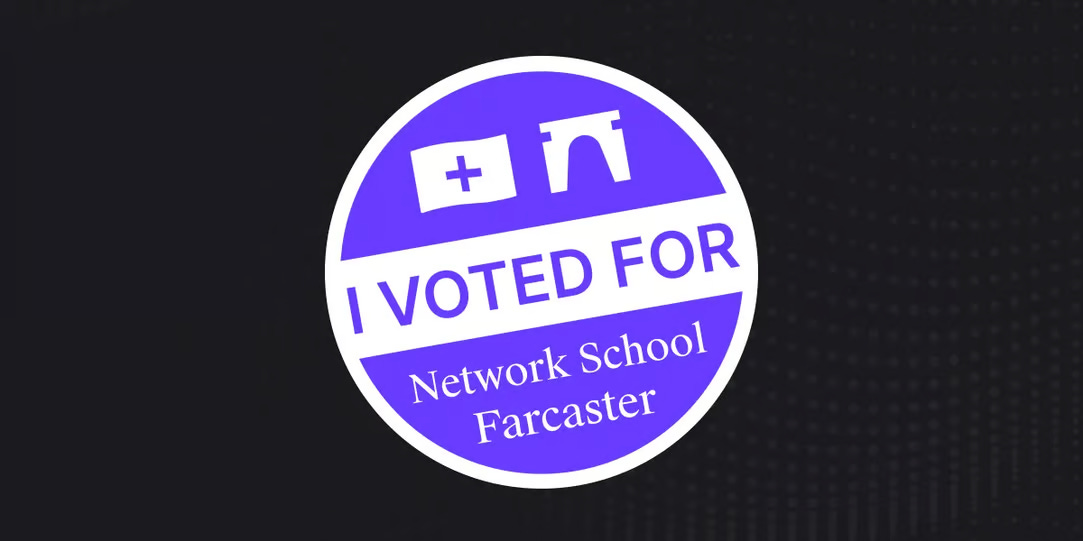
An I Voted sticker usually means you chose between candidates. This one came from a ballot with one name on it. If you clicked Vote to stay, you got the sticker. If you clicked Vote to leave, or Not now, your account went read-only.
What happened
On October 15, Balaji Srinivasan's Network School acquired Farcaster from Neynar, which had itself bought it from the original founders in January. That makes Network School the third steward of the protocol this year. The terms weren't disclosed.
Within a day the flagship app greeted everyone with a long letter. Farcaster is becoming "the Network State Protocol." The protocol stays open to anyone, but the app you're using will be moderated into "a positive-sum community for techno-optimists." To keep posting, you sign what they call a social smart contract, and with it a Network Code: written rules, "basically AI prompts," applied to every post by an open weights model. The code sorts offenses into digital felonies, misdemeanors, and infractions. A death threat or a wallet-draining scam gets you banned. Starting fights gets you suspended. Repeatedly hyping a token gets you a warning. It also rewards things, like teaching someone or correcting your own mistakes.
The letter frames the choice as a third way between two failed models of social media: the Soviet Union, where you're censored without consent, and Somalia, where anything goes. Network School wants to be "the Singapore of social media."
Then the bans started. Users reported being made read-only over posts that were months old, written before any of these rules existed. Kunal Gandhi, formerly an ecosystem lead at Eigen Labs, put it plainly: "Obliterating accounts from the get-go for past posts is pretty silly. Goes against the ethos of decentralized social." Cassie Heart, a former Farcaster engineer, said she'd been banned and announced a hard fork of the protocol. Balaji defended the approach by comparing it to President Bukele jailing "a small fraction of repeat offenders" in El Salvador.
Two arguments are tangled together here, and I agree with one of them.
Free speech was never unfettered
Here's where I land: free speech doesn't mean unfettered speech. It never has.
John Stuart Mill didn't argue for a world without limits. On Liberty sets one: "the only purpose for which power can be rightfully exercised over any member of a civilized community, against his will, is to prevent harm to others." He spent the book arguing that line should sit much further out than most societies put it. But he drew it.
My own tradition is less shy about it. The Talmud in Arachin 15b says that harmful speech kills three people: the one who says it, the one who hears it, and the one it's about. Proverbs 18:21 says death and life are in the power of the tongue. Jewish law spends whole volumes on what you may not say about another person, even when it's true. None of that is censorship. It describes how people should treat each other if they want to keep living together.
And Pirkei Avot 5:17 makes a distinction I think about every time I scroll a feed. A dispute for the sake of heaven, like the arguments between Hillel and Shammai, will endure. A dispute that isn't, like Korach's rebellion against Moses, won't. The rabbis didn't want less argument. They wanted argument aimed at the truth rather than at the other person.
Read the Network Code's list of rewarded behavior with that in mind. Teach someone. Credit your sources. Disagree civilly. Correct the record, including your own mistakes. Calm people down. That's not a dystopia. That's a decent study hall.
A private app moderating its own feed isn't the government jailing a pamphleteer, either. The First Amendment constrains Congress, not a client. Anyone who has run a community knows that a room with no rules ends up run by its loudest and cruelest people, and everyone else quietly leaves. Moderation is what it costs to keep a room people want to stay in.
So I'm not against the rules. My problem is how they arrived.
The law that reaches backward
Network School compares the Network Code to the Code of Hammurabi, and the comparison deserves a closer look. Hammurabi's laws were carved into a stone stele and set up in public. The epilogue invites any wronged man to come stand before it and have the inscription read to him, so he can understand his case. The whole point of writing law down was that you could know it before you were judged by it.
The legal philosopher Lon Fuller wrote a short parable about this in The Morality of Law. A king named Rex sets out to reform his kingdom's legal system and fails in eight different ways. He never announces the rules. When he finally publishes them, nobody can understand them. The code changes so often that no one can keep up. And at one point Rex applies his rules retroactively, judging last year's conduct by this year's code. Fuller's verdict on that last move is blunt: on its own, "a retroactive law is truly a monstrosity."
Fuller's point was that these failures don't make law harsh. They make it not law at all. A rule you couldn't have known when you acted isn't a rule you broke. It's a judgment someone decided to make about you later.
The letter itself says the Network Code is meant to bring "a degree of predictability to the digital world." Then the fine print says the rules apply to your past posts as well as new ones. You can't have both. Predictability that reaches backward isn't predictability.
It is not in heaven
The other thing that worries me is the judge.
The Network Code is run by an open weights model, so "anyone should be able to re-run these rules on the same public data to get the same results." That beats an anonymous trust and safety team making calls nobody can audit. But reproducibility is consistency, and consistency isn't legitimacy. A model that applies a bad rule identically to everyone is fair in only the narrowest sense.
The Talmud has a famous story about this, in Bava Metzia 59b. Rabbi Eliezer is outvoted on a point of law and refuses to accept it. He calls on a carob tree to uproot itself, a stream to flow backward, the walls of the study hall to bend, and each one obeys. Finally a voice from heaven declares that the law follows Rabbi Eliezer. Rabbi Yehoshua stands up and quotes Deuteronomy: "It is not in heaven." The law was given to people, to be argued out by people, and decided by people who have to live with the result. Even a heavenly voice doesn't get to override that.
It's worth noticing where that story sits in the Talmud. It's part of a discussion of ona'at devarim, wounding someone with words. The whole passage is about the damage speech can do. It ends with the sages excommunicating Rabbi Eliezer, and the Talmud describes the fallout as a catastrophe. Even a legitimate majority, enforcing a legitimate ruling, can do real harm when it punishes a person instead of answering an argument.
An AI model isn't a heavenly voice. But treating its verdicts as neutral because they're computable puts it somewhere similar, outside the room where people disagree. And the clause that unsettles me most isn't about conduct at all. It's the invitation to leave if you "don't want to build a techno-optimist community." Banning death threats is a rule about behavior. Requiring a worldview is a test of belief. I'm an optimist about what we can build, and I still don't think optimism should come with a loyalty oath.
Exit, voice, and a sticker
In 1970 the economist Albert Hirschman wrote Exit, Voice, and Loyalty, about how people respond when an institution they belong to starts going downhill. They can leave, or they can speak up and try to change it. Healthy institutions need both. Exit without voice turns members into customers; voice without exit means nobody has to listen.
Network School's answer to "who decides?" is exit, and to its credit, exit is real here. Your keys, wallet, followers, and history stay on the protocol. You can take them to another client, and Cassie Heart is already building one. That's more than any centralized platform has ever offered someone it banned. The protocol design is doing what it was supposed to do.
But look at what the vote actually asks. You aren't voting on the rules. You're voting for "the Network School Farcaster core team to set the rules," including rules not yet written. Balaji says 92.9% of recorded votes backed the change, which tells you mostly who stayed long enough to click. It's exit dressed up as voice, with a sticker.
Here's what I keep coming back to. Free speech doesn't mean unfettered speech. But fettered speech has to answer a question that unfettered speech never does: whose hand is on the chain, and when did you agree to it?